
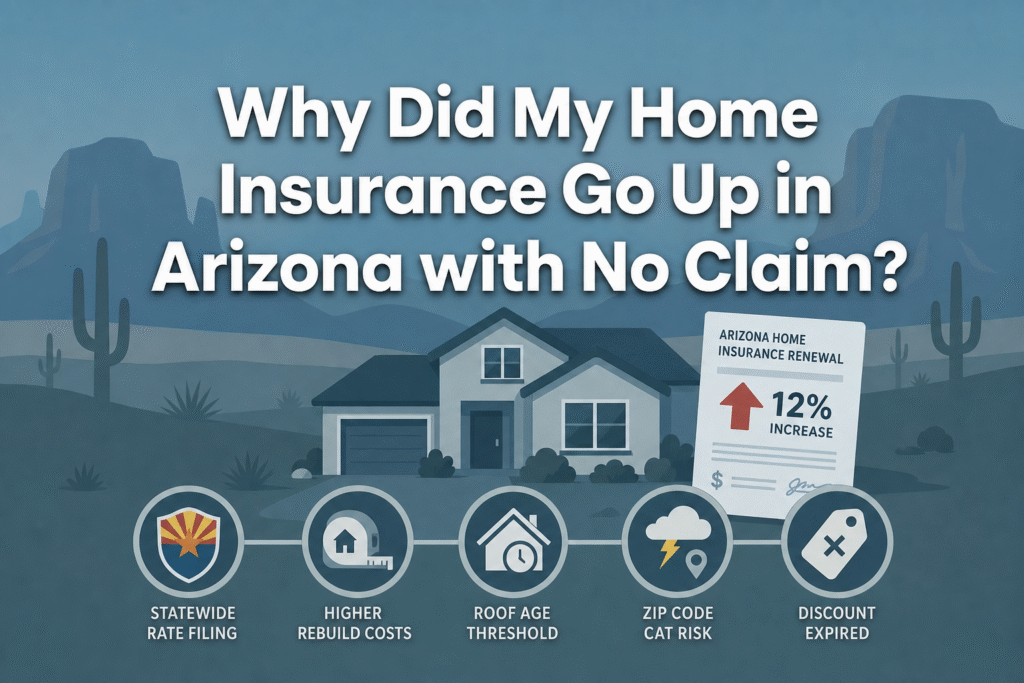
Your Arizona premium went up because most of what prices a home policy sits outside your claim history: a statewide rate filing your house belongs to, a dwelling limit that rose with reconstruction costs, a roof that crossed into an older age bracket, catastrophe scoring tied to your ZIP, or a discount that quietly expired. The declarations page shows which one. Here is how to read it before your renewal date arrives.
Why did my home insurance go up in Arizona when I haven’t filed a claim?
Because your claim history is one input among many, and in Arizona it is rarely the input that moved. Carriers file rates with the state for entire classes of homes — a construction type, a roof age bracket, a rating territory. When a filing is approved, every household in that class absorbs it. A house with nothing on its loss record sits in the same class as the house two streets over that lost a tile roof in a monsoon cell.
You are not imagining the size of the shift, either. Tucson.com reported in September 2026 that Arizona home insurance rates had soared 71 percent, alongside steps homeowners can take to cut costs. KTAR has reported that Arizona home insurance premiums are rising far faster than inflation. Arizona PIRG published a report documenting a steep increase in what Arizona homeowners pay for homeowners insurance. And Senator Ruben Gallego pressed insurance experts on Arizona premium hikes, collecting stories from Arizonans hit hard by rising costs. Four separate Arizona-anchored sources, one shared conclusion: this is a market-wide movement, not a verdict on your household.
That is the context. It is not an answer. The answer to your increase is printed on two pieces of paper you already own — this year’s renewal declarations page and last year’s. Put them side by side and the increase stops being a mystery and becomes a short list of changed numbers you can do something about.
Read your renewal declarations page next to last year’s, line by line
The declarations page — the “dec page” — is the one- or two-page summary at the front of your policy that lists your coverage limits, your deductibles, your endorsements, your discounts, and the premium. Everything else in the packet is the contract language. The dec page is the math.
Find last year’s copy. It is usually in the email the carrier sent at your last renewal, in your online policy portal under documents, or in the closing folder from when you bought the house. If you cannot locate it, your agent can pull a copy; so can the carrier’s service line. You want both years in front of you at the same time, because carriers rarely explain the increase in the notice itself. The notice announces the new number. The explanation lives in the difference between the two pages.
Compare these lines in this order:
- Coverage A — Dwelling. The amount to rebuild the structure. This is the number most other numbers key off of. If it moved, almost everything else moved with it.
- Coverage B, C, and D. Other structures, personal property, and loss of use. These are typically set as a percentage of Coverage A, so they usually rise together.
- Deductible, and any second deductible. Look for a separate wind and hail deductible stated as a percentage rather than a flat dollar amount.
- Endorsements. Water backup, equipment breakdown, service line, ordinance or law, scheduled jewelry, extended replacement cost. Read both years’ lists against each other, name by name.
- Discounts. Multi-policy, new home, protective device, paid-in-full, loyalty tier.
- Policy form and roof settlement language. HO-3 versus HO-5, and any roof surfaces payment schedule.
Circle the three or four lines that changed. That short list is the entire conversation you need to have with your agent or carrier — and it turns a vague complaint about price into a specific question somebody can actually answer.
The five things that move an Arizona premium when your claim history is empty
Here is what is usually sitting behind those circled lines.
- Reconstruction cost inflation and inflation guard. Most policies carry an automatic adjustment that raises Coverage A each year to track what it would cost to rebuild — labor, lumber, concrete, roofing crews, permits. Rebuilding a Gilbert or Mesa house is not what it cost a few years ago, so the limit climbs on its own. A higher limit is more insurance, and more insurance costs more. This one is often the single largest line on the page, and it is not a penalty.
- The carrier’s statewide loss experience. Hail runs through the East Valley and northern Arizona, monsoon microbursts peel roof tile and drop trees across Phoenix and Tucson, and wildfire losses sit in the same statewide book. A carrier that paid out heavily across Arizona files for rate across Arizona. Your household shares the result with every other household in the class.
- Reinsurance passed through the filing. Carriers buy their own insurance against catastrophe years. When that cost rises, it enters the rate filing as an expense component. Homeowners feel it as a renewal increase with no visible cause at their address, because the cause is not at their address.
- Territory and catastrophe scoring for your specific ZIP and parcel. Carriers score hail frequency, wind exposure, wildfire fuel proximity, brush distance, and distance to a responding fire station. These models get re-run. A home on the wildland edge in Cave Creek or the Catalina foothills can be re-scored even though nothing about the house changed, and two homes a mile apart can land in different territories.
- Discounts that quietly expired. New-home discounts step down as the house ages out of the bracket. A multi-policy discount disappears the month the auto policy moves elsewhere. Loyalty and tier placement can shift at a renewal cycle. Nothing on your part went wrong — a credit simply stopped applying, and the base rate underneath it was never what you were paying.
The practical takeaway: a filed rate increase applies to a class, not to a household. Being a careful owner who has not turned in a loss does not exempt you from a filing — it means that when you shop, you are an attractive risk to a carrier whose filing happens to treat your house, your roof age, and your ZIP more favorably. That is the lever you actually have.
Roof age versus roof condition: the line item that moves Arizona homes most
If one line drives Arizona home premiums more than any other, it is the roof. Hail and monsoon wind are the state’s most common severe-weather causes of loss, and the roof is what takes the hit first. Carriers rate it accordingly.
Arizona roofs also age in a way inspectors from other states underestimate. Concrete tile can look sound from the street for decades while the underlayment beneath it — the felt or synthetic membrane that is actually doing the waterproofing — bakes, dries, and fails under sustained heat. Asphalt shingle loses granules and flexibility in the same sun. A carrier cannot see any of that from a desk, so it rates what it can measure: the year the roof was installed.
That matters because carrier filings contain age thresholds. Past a threshold, a roof may be surcharged, rated into a less favorable tier, moved from replacement cost settlement to actual cash value, or — at certain ages with certain carriers — declined altogether at renewal. The thresholds differ by carrier and by roof material, which is exactly why the same tile roof on the same Chandler house can be unremarkable in one carrier’s filing and a problem in another’s.
Replacement cost versus actual cash value on a roof
Replacement cost settlement pays what it costs to put a comparable new roof on, subject to your deductible. Actual cash value pays that amount minus depreciation for the roof’s age and wear — on an older roof, that deduction can be the majority of the claim, and you fund the gap yourself. To find out which you have, look on the dec page and in the endorsement list for wording such as “roof surfaces payment schedule,” “windstorm or hail loss to roof surfaces — actual cash value,” or a depreciation schedule by roof age. If that language appeared this year and was not there last year, your coverage changed even if your premium only rose a little.
What documentation actually changes the rating
Condition does not override age unless you prove it. Supply the paperwork:
- A dated invoice from a licensed Arizona roofing contractor showing the scope — full tear-off, underlayment replacement, or tile lift-and-relay — not just a repair receipt.
- The municipal permit record, which independently dates the work.
- A roof certification or inspection report stating remaining useful life.
- Clear, dated photographs of the decking, underlayment, flashing, and valleys.
A lift-and-relay with new underlayment is a meaningful change to the risk, and some filings recognize it as a roof age reset while others credit only a full replacement. Getting that documentation in front of the right carrier is often the difference between absorbing an increase and removing its largest component.
Deductible structure: the number most homeowners read wrong
A flat deductible is a fixed dollar amount — $1,000, $2,500 — and it stays put until you change it. A percentage deductible is calculated off your Coverage A dwelling limit, which means it moves every time that limit moves.
This is where homeowners get surprised. For example: a 1 percent deductible on a $400,000 dwelling limit is $4,000. If inflation guard raises that limit to $440,000 at renewal, the same unchanged 1 percent is now $4,400 out of your pocket. The percentage on the page looks identical year over year, so most people skim past it. The dollar obligation behind it grew.
Many Arizona policies also carry a separate wind and hail deductible, often a percentage, that applies specifically to storm damage — the exact peril most likely to send you to the roof after an August microburst. Your policy can carry a modest flat deductible for a kitchen fire and a much larger percentage deductible for the hailstorm that is far more likely to happen. Confirm which deductible applies to which peril before you need the answer.
Raising a deductible does lower premium, and it is one of the few levers that works immediately. The honest tradeoff is that you have moved risk from the carrier to your savings account, and you have done it for the loss type Arizona produces most often. The question asked at the desk is straightforward: if a monsoon cell took your roof next week, could you write that check within 30 days without borrowing? If the answer is yes, a higher deductible is a reasonable trade. If it is no, lower the premium somewhere else — the point of the policy is the loss you cannot absorb.
Did my coverage change, or just the price?
Sometimes a renewal increase arrives smaller than the market would suggest, and the reason is that the carrier trimmed coverage to soften it. That is a legitimate underwriting move, and it is disclosed — in the endorsement list, where almost nobody reads.
Watch for these:
- Water backup coverage dropped or reduced — relevant to any Phoenix-area home with a basement, a sump, or a sewer line under mature landscaping.
- Roof settlement moved from replacement cost to actual cash value, or a roof payment schedule added.
- Ordinance or law limits reduced, which matters on older Tucson and central Phoenix homes where a rebuild has to meet current code.
- Personal property shifted from replacement cost to actual cash value.
- Extended or guaranteed replacement cost removed from the dwelling.
- A new percentage wind and hail deductible where a flat one used to be.
Any one of these can hold a premium down while quietly moving thousands of dollars of future exposure onto you. A 12 percent increase that keeps your coverage intact is frequently the cheaper outcome than an 6 percent increase that takes your roof to actual cash value.
If you suspect something was removed, ask in writing: Please identify every coverage, endorsement, limit, or settlement basis that differs from my prior term, and send the endorsement forms. Put it in email so you have the answer in writing. A carrier that changed something will tell you what it changed; a side-by-side of the two endorsement lists will tell you anyway.
How to re-shop an Arizona home policy without stripping coverage
Shopping is only useful if you are comparing the same thing. Most disappointing switches happen because the new quote was built on quietly smaller coverage, and the homeowner found out during a claim.
The method:
- Rebuild the quote on matched terms first. Same Coverage A, same deductible and deductible structure, same endorsement list, same roof settlement basis, same policy form. Only then look at price.
- Hand over the roof file up front. Invoice, permit, certification, photos. A carrier that knows the underlayment was replaced three years ago rates the roof differently than one working from the original build year.
- Run the auto alongside it. Multi-policy credits are among the larger discounts on an Arizona home policy, and splitting them is often what caused part of this year’s increase in the first place.
- Check payment structure. Paid-in-full and automatic-payment credits differ by carrier, and escrowed policies are typically paid annually anyway.
The traps are predictable. A quote that undercuts your renewal by a wide margin usually does it with a lower dwelling limit, an actual cash value roof schedule, a percentage wind and hail deductible presented as a savings opportunity, or a thinner endorsement list. None of those are disqualifying if you choose them knowingly. They are disqualifying when they are buried.
This is the part an independent agency does differently than a captive office. Placing business with several carriers means seeing the same Gilbert or Mesa address run through multiple filings on identical terms — which carrier’s filing penalizes a 16-year-old tile roof and which one barely notices it, which one scores your ZIP for hail aggressively, which one still offers the endorsement your current carrier dropped. Nobody can promise you a particular number. What can be shown is which carrier’s filing treats your specific house most favorably on matched coverage, and what you would be giving up to go lower.
Your four weeks before the renewal date: what to do, in order
Arizona renewal notices generally arrive weeks ahead of the effective date, which gives you a workable runway. Use it in this order:
- Week one. Pull both declarations pages, circle every line that changed, and confirm whether your deductible is flat or a percentage of the dwelling limit.
- Week two. Gather documentation — roof invoice and permit, any re-pipe, electrical panel, or HVAC replacement, security or water-shutoff devices. These are rating inputs that only help if someone knows about them.
- Week three. Request quotes on matched coverage, not matched price, and ask each one to state the roof settlement basis in writing.
- Week four. Decide and bind before the current policy lapses. Do not cancel anything until the replacement policy is confirmed in force.
If your premium is escrowed, deciding early matters more, because your servicer needs time to adjust the payment and a late switch can trigger a shortage notice or a force-placed policy. Sometimes accepting the increase is the right call — your coverage is intact, your roof is rated fairly, and the increase is the statewide filing doing what it does. Sometimes a single line on the page is doing all the damage, and it can be fixed. You will not know which until you read the two pages together.