
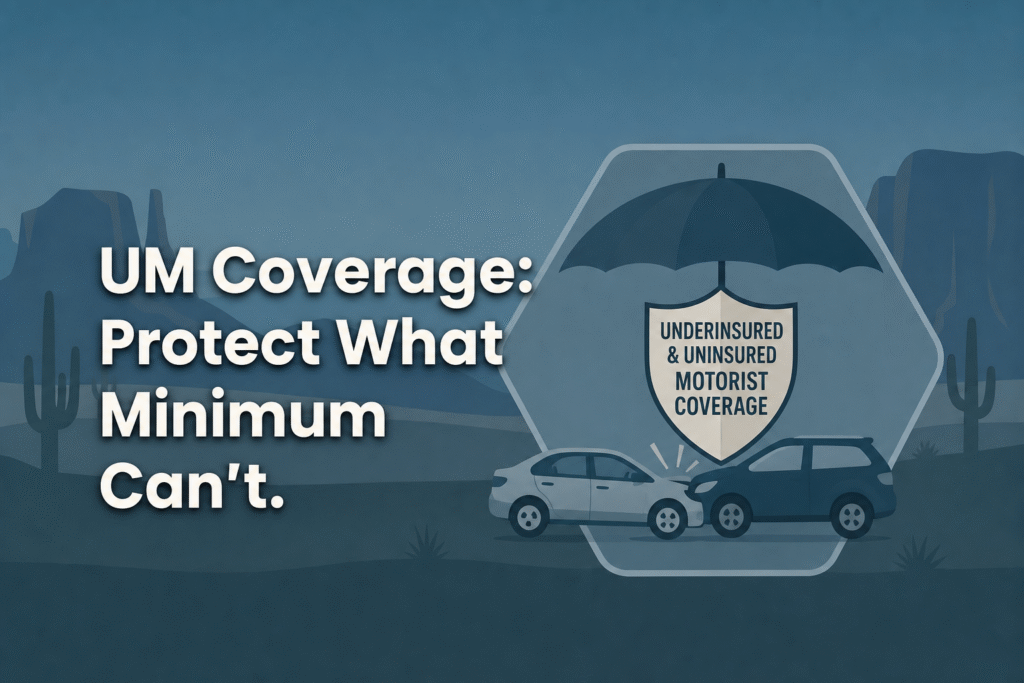
If the driver who hit you carried Arizona’s minimum bodily injury limits and your injuries cost more than that, the coverage that pays the difference is your own underinsured motorist bodily injury limit. If the driver had no insurance at all, or left the scene, uninsured motorist bodily injury responds instead. The practical answer for most Arizona households is to set that limit equal to your own liability bodily injury limit.
The other driver had state minimums and you’re the one with a hospital bill
Picture a weekday afternoon at an intersection in Chandler. A driver turns left across your lane, clips your front quarter panel, and everyone gets out talking and apologizing. By that evening your neck is stiff. By Thursday you are at urgent care. The following week you have had imaging, a specialist visit, and a referral for several weeks of physical therapy. The other driver’s insurance company calls, accepts fault, and then says the sentence that changes the whole conversation: their policyholder carried the state minimum, and that number is the ceiling on what their policy will ever pay you.
Arizona requires drivers to carry at least $25,000 in bodily injury liability per person and $50,000 per accident. Those are real dollars, and for a fender tap with no injuries they are plenty. But an ambulance transport, an emergency room visit, a CT scan, and a short course of therapy can move toward that per-person figure without anything dramatic happening. Add a fracture, an outpatient surgery, or two months you cannot work your normal hours, and the at-fault policy is exhausted long before your bills stop arriving.
That is the moment most drivers learn the uncomfortable part. Once the other person’s limit is gone, it is gone. There is no appeal, no second layer, and no requirement that they carry more. The question stops being what does their policy cover and becomes what did I buy for myself.
We have written separately about what Arizona’s minimum auto requirements are and why they function as a legal floor rather than a plan. This post is the mirror image of that article. It is about the lines on your own declarations page that step in when the person who hit you was perfectly legal and financially unequipped to make you whole.
Which part of your own policy actually pays — and in what order
After a crash with an underinsured driver, several coverages can be in play at once, and they do different jobs. Knowing which does what is the difference between feeling ambushed and knowing what to file.
- Uninsured motorist bodily injury (UMBI). Pays for injuries to you and your passengers when the at-fault driver has no liability insurance at all, or cannot be identified, such as in a hit-and-run. Your own policy stands in the shoes of the driver who should have been insured.
- Underinsured motorist bodily injury (UIMBI). Pays when the at-fault driver does carry insurance, but not enough. This is the coverage that answers the scenario in this post.
- Medical payments (MedPay). A smaller, no-fault bucket that can pay medical bills early, regardless of who caused the crash, while the liability claim is still being sorted out.
- Collision. Pays to repair or replace your vehicle, subject to your deductible, no matter whose insurance is slow or missing.
- Your health insurance. Often the first payer in practice for treatment, with reimbursement sorted out later from the settlement.
Here is the distinction most Arizona drivers miss. Underinsured motorist coverage does not pay from the first dollar. It fills the gap above what the at-fault driver’s policy pays. If the other driver carries the state minimum per person and your UIM limit is higher, the room available to you is generally the difference between the two numbers, not your full limit stacked on top. That single mechanic is why a UIM limit set at or near the state minimum does almost nothing: there is no gap left to fill.
The second thing people get wrong: uninsured and underinsured motorist bodily injury do not repair your car. They respond to human injuries, lost wages, and related damages. The vehicle is handled by the at-fault driver’s property damage liability, by your collision coverage, or in some cases by uninsured motorist property damage if your carrier offers it and you bought it. Ask specifically which of those you have.
Order of operations usually looks like this: MedPay and health insurance keep treatment moving, the at-fault carrier pays up to its limit, and then your UIM claim addresses what remains. Meanwhile, collision gets your car fixed on a separate track. Using collision for the car and UIM for your injuries is not double-dipping; they are two different losses from one crash, paid by two different parts of the contract.
How much uninsured motorist coverage do I need Arizona? Match your liability limit
The default answer is simple enough to apply this afternoon: set your uninsured and underinsured motorist bodily injury limits equal to your liability bodily injury limits. If you carry 100/300 in liability, carry 100/300 in UM and UIM.
The logic is worth sitting with, because it settles the question without guesswork. When you bought liability coverage, you already made a judgment about what a seriously injured person’s claim is worth — you decided how much protection a stranger should have if you were the one who caused the harm. Matching simply says your own spouse, your own kids, and your own lost income deserve at least the same number you were willing to extend to someone else. Any gap between the two is a statement that other people’s injuries matter more than your family’s, and almost nobody means to say that.
That gives you a floor. From there, a few household facts argue for stepping up to a higher tier:
- Income you would lose. UM/UIM covers lost wages, not only medical bills. A household that depends on one earner who cannot work for several months needs a bigger number than a retired couple with fixed income.
- How many people are usually in the car. Per-accident limits get divided among everyone hurt. A family of five commuting together needs more room under the per-accident figure than a solo driver.
- Miles and traffic exposure. A daily run up the I-10 or across the Loop 202 at rush hour is a different risk profile than a five-mile trip inside Gilbert.
- Health plan design. A high-deductible plan means more of the early cost lands on you before anything else responds.
- Assets and future earnings. If you carry or are considering an umbrella policy, ask whether it extends to uninsured motorist claims. Many umbrellas cover liability only unless UM/UIM is added, and the underlying auto limits often have to be at a certain level first.
One more framing that helps people decide: picture the worst crash you consider realistic on a road you actually drive, then ask what that would cost in medical care, therapy, and missed work over a year. The limit that covers that picture is your answer. The limit that covers only a trip to the ER is not a plan — it is a hope that the crash stays small.
What raising your UM/UIM limit actually costs on a real Arizona quote
Most people assume that doubling or tripling a limit doubles or triples the price, and that assumption is why so many Arizona drivers quietly leave UM/UIM at the bottom of the page. When we quote a Chandler or Tucson household across several carriers and put the options side by side, the premium difference between a minimum-level uninsured motorist limit and a substantially higher one is routinely one of the smaller line items on the entire quote — noticeably smaller than the same jump on liability, and often smaller than the difference between two deductible choices.
There is a structural reason for that. Liability coverage has to respond every time you cause harm to anyone, which is a broad set of circumstances. Uninsured and underinsured motorist coverage only pays in a narrower slice of events: someone else was at fault, and that person was uninsured, underinsured, or unidentified, and somebody in your car was actually injured. Fewer triggering events means the extra limit is priced differently than it would be on the liability side. That does not make it free, and the spread varies by carrier, by vehicle, by driving record, and by territory — a Tucson garaging address and a Scottsdale one do not price identically.
Which is exactly why we think the number belongs on paper rather than in a conversation. When we run a comparison, we show the same household the same limits at several carriers, then show what the next tier up adds for each one. Sometimes two carriers that look close on the base quote are far apart on the cost of the higher limit, and the better long-term answer is the one that is not the lower number today. You get to see the price of the protection instead of guessing at it, and then decide whether that specific dollar amount is worth it to your household. We will not pretend to know in advance what your number will be, and any agent who quotes you one before pulling your information is making it up.
The honest version of the advice is this: ask for the delta, in writing, carrier by carrier. It is a short question that frequently changes what people buy.
What happens if it was a hit-and-run or a phantom vehicle?
Uninsured motorist coverage is also the part of your policy that responds when nobody sticks around. Two situations come up constantly on Arizona roads.
The first is a straightforward hit-and-run: a car strikes you in a parking lot off Baseline, or sideswipes you on the freeway, and keeps going. There is contact, there is damage, and there is no one to bill. Your UM bodily injury coverage addresses injuries to you and your passengers, while your vehicle is generally handled by collision or by uninsured motorist property damage if you carry it.
The second is the one people have never heard of until it happens: the phantom vehicle. A driver drifts into your lane on the I-10, you swerve to avoid being hit, and you end up in the median or against a barrier. The other car never touches you and never stops. Because there was no contact, these claims are examined more closely — carriers want evidence that another vehicle actually caused the crash rather than a single-car loss of control. Documentation does the heavy lifting here:
- Call police from the scene and get a report started. A report filed days later is weaker than one taken at the time, and some policies have notification expectations for unidentified-driver claims.
- Get independent witnesses. Names and phone numbers from people who are not your passengers carry real weight on a no-contact claim.
- Save dash cam footage immediately. Many cameras overwrite on a loop. Pull the card the same day.
- Photograph everything. Skid marks, debris field, lane position, damage, and the surrounding roadway.
Arizona adds its own texture to this. Monsoon season brings blowing dust and sudden downpours that drop visibility on freeway corridors with little warning, and swerve-to-avoid incidents cluster in exactly those conditions. Debris in the roadway, a load that was not strapped down, or a driver merging blind in rain all produce crashes where the other party is simply gone. Reporting promptly and preserving evidence is what keeps those claims from being treated as your fault alone.
The paperwork that quietly leaves Arizona drivers with no UM coverage at all
A surprising number of drivers who think they have this coverage do not. Arizona law requires insurers to offer uninsured and underinsured motorist coverage, and a driver who does not want it has to decline it in writing — the framework lives in A.R.S. § 20-259.01. On a fast online purchase, that written rejection is often a checkbox on a screen you clicked through in under a minute while trying to finish the quote. Nobody remembers making the decision, because it did not feel like one.
Worse, the rejection carries forward. Once it is on file, it typically follows the policy through renewal after renewal until a human being asks for it to be changed. A policy you bought in a hurry in 2019 can still be rejecting the coverage today.
Here is how to check in about two minutes. Pull up your declarations page — the summary pages your carrier sends at each renewal, usually also available in your online account. Look for lines abbreviated like this:
- BI or Bodily Injury Liability — what you pay others when you are at fault, shown as two numbers such as 100/300.
- UMBI or Uninsured Motorist Bodily Injury — what pays you when the other driver has nothing.
- UIMBI or Underinsured Motorist Bodily Injury — what pays you when the other driver has too little.
If the UMBI or UIMBI lines show a dollar amount, you have the coverage at that limit. If they show $0, none, declined, rejected, or are simply missing from a page that lists every other coverage, you do not have it, and your own policy will not step in behind a minimum-limits driver. Compare those lines directly against your bodily injury liability line. If the two numbers do not match, you now know the size of the gap you are carrying, and fixing it is an endorsement request, not a new policy.
Households with teens, motorcycles, and multiple vehicles need a different number
The right limit is not a single figure for everyone in Arizona; it moves with what is in your garage and who is behind the wheel.
A new driver changes the math on every car. When a teenager in Gilbert or Mesa starts driving to school and work, the household’s total exposure rises, and so does the number of trips where that teen is a passenger in a friend’s car. Your UM/UIM is often what protects them in someone else’s vehicle.
Motorcycles burn through limits fast. Rider injuries tend to be more severe, and treatment that follows a serious motorcycle crash can exceed a minimum bodily injury limit almost immediately. If you ride, the matching rule is a starting point, not a stopping point.
Multi-vehicle households should check for consistency. It is common to find three cars on one policy with different limits because they were added in different years. Which coverage applies can depend on which vehicle was involved, so an inconsistent lineup creates a weak link you will only discover at the worst time.
Passengers and pedestrians are the surprise. UM/UIM generally follows people as well as cars, which means it can respond when you are hurt riding in a friend’s vehicle, struck while walking in a crosswalk, or hit on a bicycle. Resident relatives — family members living in your household — are often covered too, even in a car that is not on your policy. The specifics live in your policy language, so confirm the definition of an insured person with your agent rather than assuming.
Check your own limits in ten minutes: what to pull and what to ask
You can settle this today without waiting for a renewal notice.
- Find your current declarations page, in your email, your carrier’s app, or the glove box.
- Locate the bodily injury liability line and write down both numbers.
- Locate the UMBI and UIMBI lines and write down those numbers.
- Flag any entry showing $0, declined, rejected, or missing entirely.
- Compare the two sets of numbers. If UM/UIM is lower than liability, you have found your gap.
- Bring the page to an agent who can quote the same limits across more than one carrier.
Then ask these questions out loud:
- Does my UM/UIM bodily injury limit match my liability bodily injury limit, and if not, why not?
- What does the next tier up cost on each carrier you are quoting?
- Does this policy protect me as a passenger in someone else’s car, as a pedestrian, or on a bicycle?
- Do I have uninsured motorist property damage, or is my car covered only by collision?
- How does MedPay interact with my health plan, and how much should I carry?
- Is there a written rejection on file from a prior purchase that is still carrying forward?
We are happy to run that comparison for your household and show you the limit options side by side, carrier by carrier, so the decision is based on your actual numbers instead of a general rule.