
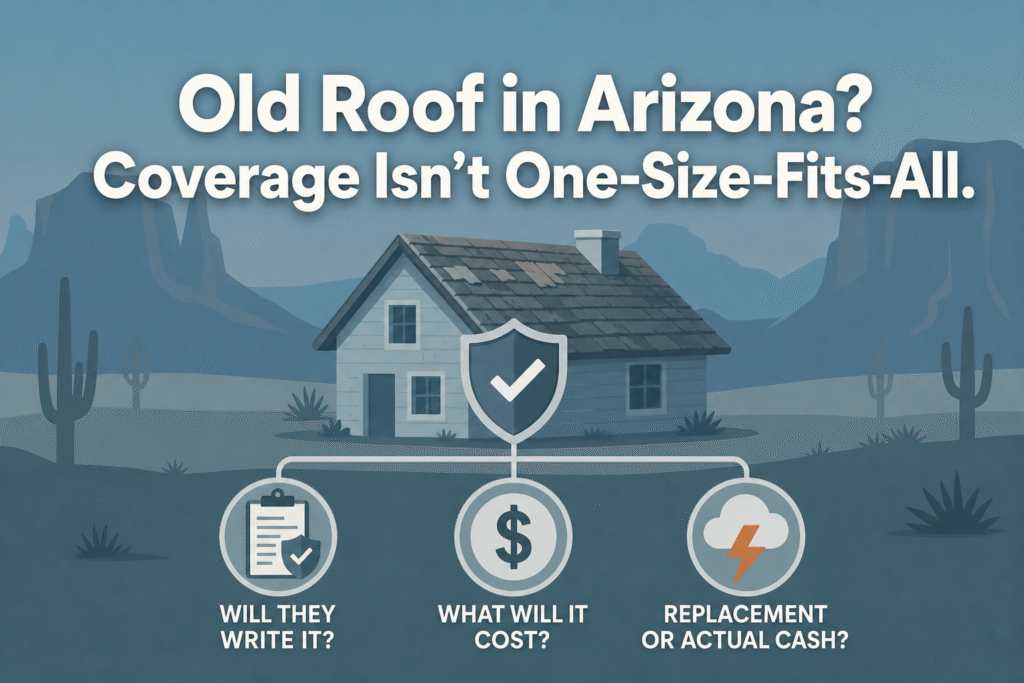
Yes — most Arizona carriers will still insure a home with an older roof. But “cover” is really three separate decisions: whether a company will write the policy at all, what it charges once it sees the roof age, and how it would settle a storm claim — a new roof, or a depreciated check. The same 20-year-old shingle roof in Gilbert can draw three different answers from three carriers in one afternoon.
Will home insurance cover my old roof in Arizona?
Start with the one point every carrier agrees on. A homeowners policy pays for sudden, accidental damage — wind that peels shingles off during a monsoon downburst, hail that bruises the mat, a microburst that drives a palm frond through the decking. It does not pay to replace a roof that quietly wore out under two decades of Arizona sun. Arizona roofing contractors who publish on this exact question say the same thing in their own words: insurance covers storm, hail and wind damage, not age or neglect. Wear is a maintenance expense. A storm is a claim.
Everything else sits downstream of that line, and that is where homeowners get confused. Once an underwriter accepts that your roof is the single component most likely to generate a loss in a hailstorm, the company has three levers it can pull:
- Price. Write the policy, charge more for the roof age.
- Appetite. Decline the risk at new business because the roof falls outside what the company is willing to put on its book this year.
- Settlement basis. Write the policy at a lower premium, but change how a roof claim gets paid — replacement cost drops to depreciated value.
So the honest answer to “will home insurance cover my old roof in Arizona” is a question back: covered by which carrier, on what terms, and settled how? The rest of this post walks through all three verdicts, what drives each one, and what is still negotiable before a storm ever hits.
Same roof, three answers: why one carrier surcharges, one declines, and one pays depreciated value
Here is a composite that plays out most weeks in the Valley. A 2003 tract home in Gilbert, roughly 2,400 square feet, original architectural shingle roof, no prior claims, owner shopping because the renewal jumped. One address, one application, several carriers quoted in a single sitting.
Carrier A writes it with a roof-age charge and keeps replacement cost. The underwriting system reads the roof age, applies a rating factor, and issues the quote. The premium is the highest of the three — and the roof is still insured on a replacement cost basis, meaning a covered storm loss is settled at what it costs to put a comparable new roof on today, minus the deductible.
Carrier B declines at new business. Not because the roof is failing, and not because an adjuster inspected it. The shingle age simply sits outside the window that company is willing to accept on new applications this year. Some carriers in this position will reconsider the same house the day you send a re-roof invoice.
Carrier C writes it, and quietly moves the roof to actual cash value. This is the quote that looks attractive on price. Actual cash value means replacement cost minus depreciation for age and wear. On a 20-year-old shingle roof, that depreciation is substantial, and the homeowner covers the difference out of pocket on top of the deductible.
Two terms worth pinning down before the rest of this gets technical. Replacement cost pays to replace damaged property with like kind and quality at current prices. Actual cash value pays replacement cost minus depreciation — an accounting for the life the roof had already used up before the storm arrived.
None of these three carriers made a mistake, and none is the “good” company. They are three different risk appetites, shaped by each company’s hail loss experience in Maricopa and Pima counties, how concentrated its book already is in the Phoenix metro, what its reinsurance costs this year, and what its inspection vendors have been reporting on roofs of that vintage. Appetites also shift — a company that declined older shingle last spring may open up this fall.
The practical problem is sampling. A homeowner who calls one company hears one verdict and draws a conclusion from a sample of one: either “nobody will insure my roof” or “my roof is fine, I got a great rate.” Both conclusions can be wrong at the same address on the same day.
What an underwriter actually looks at besides the number of years
Roof age is the headline, but it is rarely the only thing in the file. By the time a quote comes back, an underwriter may have looked at several of these:
- Aerial and street-level imagery. Most carriers now pull current overhead photography of the property automatically, and many run image analysis that flags discoloration, patching, missing tabs, tarps, staining and debris.
- Prior claim history at the address. Loss history follows the house, not only the owner. A prior wind or hail payout on a roof that was not replaced afterward is a specific concern.
- Permit and re-roof documentation. Whether a permit was pulled for the last re-roof, and whether the work was a full tear-off or a layover on top of the existing shingles. Overlaid roofs are treated less favorably by many carriers.
- Visible condition. Granule loss, curling, exposed fasteners, cracked or slipped tile, failing flashing at penetrations, and ponding or blistering on a flat or foam roof.
- Underlayment age on a tile roof — which is often a different number than the tile age, and more about that below.
There is one detail that costs Arizona homeowners real money every year. “Roof age” on an application means the age of the covering — the shingle, tile or coating layer — not the age of the house or the trusses. A homeowner who re-roofed seven years ago but cannot produce anything proving it often gets rated as though the original roof is still up there, because the underwriter has an age from public records and nothing to contradict it.
So before you ask for quotes, pull together whatever you have: the re-roof invoice with the completion date, the permit number if one was pulled, the material and manufacturer, the workmanship or manufacturer warranty, whether the job was a tear-off or an overlay, what underlayment went down, and a few dated photos. If you bought the home recently, the inspection report from the purchase and the seller’s disclosure often contain the roof date and condition notes. That packet frequently moves a house from one verdict to a better one — sometimes from a decline to an offer, sometimes from actual cash value back to replacement cost. It costs you an email and it changes the rating input, which is a rare combination in this business.
Is there a roof age cutoff in Arizona — and does it apply at renewal too?
Arizona does not set a roof-age limit by statute. There is no state number past which a home becomes uninsurable. What exists instead is carrier appetite, written into each company’s underwriting guide, and those guides differ from one another and get revised.
Cutoffs tend to work in a few distinct ways, and the difference matters:
- A new-business threshold. Past a certain roof age, the company will not accept a new application, period, until the roof is replaced.
- An inspection trigger. Past a certain age the roof gets looked at rather than auto-declined. An inspector or an aerial review determines the outcome, and a well-maintained roof clears.
- A conditional offer. The company will write the house, but only with a roof-surfacing actual cash value endorsement attached, or only at a higher wind and hail deductible.
- A renewal threshold, which is usually more generous. Many carriers will keep renewing an existing customer whose roof has aged past what they would accept from a stranger.
That last point explains a situation homeowners find maddening. Your neighbor with the identical roof has had the same company for 14 years and renews without a word, while your new application on the same floor plan gets declined. The company is not being inconsistent — it is applying two different rules, one for risks already on its book and one for risks it is choosing to add.
Renewal is not permanent shelter, though. Carriers re-run aerial imagery on existing policies, and a non-renewal notice triggered by an overhead photo of a weathered roof has become a common piece of mail in older Phoenix-area neighborhoods. As one national report on rising non-renewals put it, nothing alarms insurers faster than an aging roof. If that notice arrives, read the stated reason carefully — “roof condition” and “roof age” are different findings, and the first one can sometimes be cured with repairs and photographs.
The specific numbers — which age triggers which action, and whether tile and shingle are treated separately — vary by company and are readable in the underwriting guidance at quote time. That is a question worth asking your agent directly about your address rather than assuming a figure you read somewhere applies to your carrier.
Replacement cost vs. actual cash value on the roof: what the check actually looks like
Picture an actual storm. A late-July monsoon cell runs through Chandler, and the next morning you have missing shingles across the west-facing slope and a leak over the garage. A roofer writes an estimate for a full replacement. What does the policy pay?
If the roof is insured at replacement cost, the carrier generally pays the cost of a comparable new roof, minus your deductible. Many policies pay actual cash value first and release the remaining “recoverable depreciation” once the work is completed and you submit the final invoice — so even on a replacement cost policy, the money often arrives in two pieces.
If the roof is insured at actual cash value, the carrier pays the depreciated value of the damaged roofing, minus your deductible, and there is no second check. Depreciation is applied by age, and sometimes by material — some endorsements include a printed roof payment schedule showing exactly what percentage of replacement cost is payable at each age of each roof type. Ask to see that schedule. It converts a vague concept into a number you can plan around.
Then the deductible lands on top. Arizona policies increasingly carry a separate wind and hail deductible, stated as a percentage of your dwelling limit rather than a flat dollar amount. As an illustration only: on a $400,000 dwelling limit, a 2% wind and hail deductible is $8,000 — against an all-other-perils deductible that might be $1,000 on the same policy. Stack a percentage deductible on top of a depreciated roof settlement and a homeowner who expected a new roof can end up funding most of one.
Here is what to look for on your own declarations page and endorsement list, in the vocabulary carriers actually use:
- Endorsement titles containing roof surfacing, actual cash value loss settlement, roof payment schedule, or windstorm or hail loss to roof surfacing.
- A deductible line that reads as a percentage, or a second deductible listed separately for wind and hail.
- A cosmetic damage exclusion, which can exclude dents and marring that do not affect function — relevant on metal and tile.
- Any matching or line-of-sight language that governs whether undamaged slopes get replaced to match.
And be fair to the trade-off. A policy with an actual cash value roof is not a trick, and the premium difference is real. For a landlord with an older rental in Tucson, or a homeowner who already knows the roof is due and has budgeted for it, accepting depreciated roof settlement in exchange for a lower premium can be a sound decision. The problem is discovering it the week after a storm instead of choosing it at the kitchen table. Settlement basis belongs on the comparison sheet next to premium, deductible, limits and exclusions — not buried three pages into the endorsement list.
Tile, shingle, or foam: how Arizona roof materials change the underwriting answer
Material changes the question as much as age does.
Concrete and clay tile create the most confusion. The tile itself can outlast the house, but the felt or synthetic underlayment beneath it is the part that actually keeps water out, and that is what fails. Carriers differ on which number they want — some rate the tile, some want the underlayment date, some ask for both. If your tile is original to a 1998 build but the underlayment was replaced in 2018, say exactly that and send the invoice. Answering “my roof is 27 years old” when the waterproofing layer is seven years old can cost you a surcharge you do not owe.
Asphalt shingle ages differently in sustained desert heat and UV than it does in cooler climates. Underwriters know it, which is part of why shingle appetite windows in Arizona can be tighter than what you would read on a national insurance site.
Foam and flat roofs bring their own questions: when the roof was last recoated, what the recoat schedule is going forward, whether there is ponding after a storm, and whether parapet flashing is intact. A documented recoat history helps here the same way a re-roof invoice helps on shingle.
The takeaway is simple. On an Arizona home, “how old is your roof” often has two correct answers, and giving the underwriter the full, documented picture tends to work in your favor.
Document the roof before monsoon season, not after the storm
Nearly every disputed roof claim in Arizona turns on one question: was this sudden storm damage, or pre-existing wear that was already there? Contractors who handle these claims report the same pattern — a surprising number of claims get delayed or denied because those two categories get mixed up. The homeowner who can show what the roof looked like in May is in a materially stronger position in August.
Build the file before the first cell forms over the Superstitions:
- Dated photos from the ground on all four elevations, plus overhead shots if you can get them safely.
- The most recent re-roof invoice, permit, and warranty documents.
- Any inspection or maintenance reports, including the home inspection from when you bought.
- Receipts for repairs — flashing, a few replaced tiles, a recoat.
- All of it stored somewhere retrievable from your phone, not in a drawer in the garage.
One caution about the knock on the door after a storm. Free post-storm inspections are frequently offered by parties who get paid only if a claim succeeds, which is a different set of incentives than yours. Before you sign anything — particularly an assignment of benefits or a contingency agreement — read what you are signing, confirm the contractor is licensed in Arizona, and call your agent or carrier first. Reporting the loss yourself costs nothing and keeps you in control of the file.
Quoted high, non-renewed, or facing a re-roof: what to do next
If an old roof just drove your premium up or got your policy non-renewed, work the options in this order.
Shop the risk across carriers with different roof appetites before you accept the verdict. One decline is one company’s appetite, not a market consensus. The whole point of quoting several carriers against one address is to see which of the three verdicts each one issues.
Ask whether partial work changes the classification. On a tile home, replacing underlayment may reset the age that matters. Repairing flashing and clearing flagged condition items can resolve a condition-based non-renewal even when nothing can be done about the calendar.
Time a re-roof against your renewal date, and send the invoice the day it is finished. Carriers generally re-rate on documentation, and the sooner the completion date and permit are in the file, the sooner the roof-age factor comes off.
Understand when a surplus-lines market is the realistic answer. For some older roofs, the practical choice is a non-admitted carrier — broader appetite, different pricing, and coverage terms that need a careful read, including how the roof is settled.
Compare the whole picture: deductible structure, wind and hail deductible, settlement basis on the roof, exclusions and limits — not premium alone. A quote that is cheaper because the roof is on actual cash value is a different product, not a better deal.
If you want a straight read on how several carriers would each treat the roof on your specific Arizona address, that comparison is exactly what an independent agent does at quote time.