
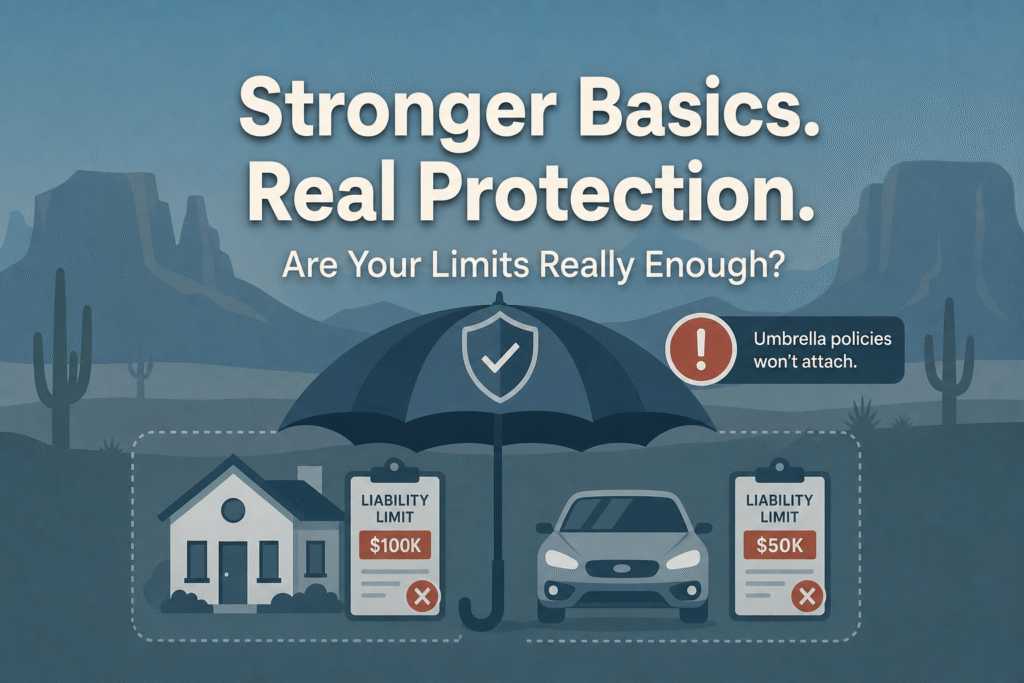
You probably need an umbrella policy if what you own — home equity, savings, a rental property, a business interest, future wages — is worth more than the liability limits printed on your Arizona auto and home policies. Size it against what a court judgment could reach, not against your income. And before you shop one, look at the limits underneath it, because most umbrella carriers will not sit on top of bare-minimum auto liability.
Your liability limits were set for the life you had, not the one you have now
Most liability limits in Arizona households were chosen once, quickly, years ago — often at a closing table on a first house, or during a short phone call with a prior carrier that led with price. At the time, the number matched the life. One car. A starter home with a mortgage nearly as large as the house. A modest balance in savings. Not much for anyone to come after.
Then a decade happened. The house in Gilbert appreciated. The mortgage got paid down. A retirement account grew into something real. A second car showed up, then a third when your oldest got a license. Somebody put in a pool. You bought a rental in Surprise and kept it in your own name because that was simpler at the time. Every one of those changes increased what you own and what a claim against you could reach — and not one of them touched the liability limits sitting quietly on your policies.
Liability is the one coverage households do not re-shop, because nothing has gone wrong yet. You notice your deductible when a monsoon strips shingles off the roof. You notice comprehensive when a rock cracks a windshield on the freeway. You notice your premium every six months. Liability limits stay invisible until the day they matter, and on that day they are the only number on the page that counts.
Two figures are worth finding right now. On your auto policy, look for bodily injury liability, written as a per-person limit and a per-accident limit. On your homeowners or condo policy, look for personal liability, usually labeled Coverage E. Those two numbers are the ceiling on what your insurer pays when you are the one who caused harm. Everything above them is yours to cover, out of whatever you have managed to build.
That gap is what this guide is about — and an umbrella policy is only half of the fix. The other half is the structure underneath it, which is where most Arizona households turn out to have a problem they did not know about.
What an umbrella policy actually is — and what it sits on top of
An umbrella policy is a separate liability policy that begins paying after the liability limit on your home or auto policy has been used up. If an at-fault crash produces injury claims larger than your auto bodily injury limit, the auto policy pays to its limit and stops; the umbrella responds from that point up to its own limit. One umbrella typically sits over several policies at once — the auto policy, the homeowners or condo policy, a landlord policy on a rental you own, and, when they are listed properly, a boat, a travel trailer, or an off-road vehicle.
The policies underneath have a name: your underlying limits. Hold onto that term, because it drives most of what follows. An umbrella carrier decides whether to issue a policy — and what to charge for it — based on how high those underlying limits are, and it requires you to keep them at that level for as long as the umbrella stays in force.
It helps to be blunt about what an umbrella is not. It is not extra dwelling coverage, so it adds nothing to the amount available to rebuild your house after a fire or a hailstorm. It is not extra collision or comprehensive coverage, so it does not pay for your own truck. It is not a deductible buy-down. And it does not pay for injuries to you or to members of your own household, or for damage to your own property. It responds when someone outside your household claims that you, a family member, a pet, or your property caused them harm.
The piece households overlook most often is defense. Umbrella policies generally pay the cost of defending you against a covered claim — attorneys, expert witnesses, depositions, months of process — and frequently pay it in addition to the limit rather than out of it. A lawsuit can burn through real money before anyone establishes whether you were at fault at all. Without an umbrella, that is a bill you handle personally, and it arrives whether or not the claim against you eventually holds up.
One more structural point that surprises people: an umbrella generally broadens as well as heightens. Many umbrella forms pick up certain personal injury claims — libel, slander, false arrest allegations — that a standard homeowners policy treats narrowly or excludes. The exact list varies by carrier, which is one of several reasons the form matters as much as the limit.
Do I need umbrella insurance Arizona how much liability is enough: start with the situational test
Skip the generic checklist. The households we write umbrella policies for in Arizona tend to share a handful of specific exposures, and each one has the same characteristic: it can generate a claim larger than a standard home or auto liability limit, in a single afternoon, without anyone doing anything reckless.
- A pool or spa. In most of the state it is usable through much of the year, which means neighbors, kids’ friends, and guests are around water at your house far more often than in a colder climate. Pool claims are among the more serious liability events a homeowner can face.
- A dog with a bite history or a breed a carrier has flagged. Some homeowners policies limit or exclude animal liability outright, and an umbrella will generally follow that exclusion — which is exactly why the conversation has to happen before you buy, not after.
- A teen or newly licensed driver on a shared vehicle. This is the single most common reason Arizona parents call us about limits. The underwriting side of adding a young driver is its own conversation; the liability side is simpler and harsher, because a young driver in a family vehicle exposes the whole household’s assets.
- A rental or short-term rental held in your own name. A tenant’s guest who falls on a stairway sues the owner, and the owner is you.
- Desert toys. Side-by-sides and dirt bikes on state land, boats on Roosevelt or Lake Pleasant, a travel trailer towed up toward the Rim. These carry their own liability, and they have to be disclosed and scheduled correctly for an umbrella to follow them.
- A seat on an HOA or nonprofit board. Volunteer board service creates personal exposure that many people assume the association handles for them. Some umbrellas extend limited coverage here; some do not.
- Hosting. The birthday party, the graduation gathering, the holiday dinner where someone else’s guest drives home. Host liability is real, and it attaches to the property owner.
If two or more of those describe your household, the question is no longer whether an umbrella applies to you. It is how much, and whether your current policies can even support one. And if none of them describe you today, note how many are one life change away — a pool at the next house, a license for the kid who is fifteen now, a rental bought with an inheritance.
How much liability is enough for an Arizona household? Do the math with your own numbers
The honest answer is that there is no published average worth quoting to you, because the right limit is a function of your balance sheet, not of a national figure. Here is the worksheet we walk clients through at review time. Use your real numbers, not estimates that make you comfortable.
- Home equity. Current market value minus what you still owe. For households that bought in the Valley or Tucson years ago, this is usually the line that surprises people.
- Non-retirement savings and investments. Checking, savings, brokerage accounts, CDs, cash held for a future purchase.
- Equity in rental or investment property. Each property, separately, including anything held jointly with family.
- Business interests. An ownership stake in a company, equipment, receivables, or a practice.
- Future wages. This is the line almost everyone skips. A judgment larger than your insurance and your assets can reach into what you earn for years afterward. A household with modest savings and a strong income still has something worth defending.
Total those, and you have a rough picture of what a claim could pursue. An umbrella is sized against that number — what a judgment could reach — not against your income alone and not against the price of your house.
The instinct we hear most often is some version of “my house is protected, so I only need a little.” That reasoning breaks down in two places. First, protections that shelter part of your home equity do nothing for your brokerage account, your rental property, or your paycheck. Second, protections have boundaries, and boundaries are argued about in court by people who do this for a living. Insurance is the layer that keeps you out of that argument in the first place.
Two Arizona-specific wrinkles are worth raising with a professional. The state has a homestead exemption that shields a portion of the equity in a primary residence — A.R.S. § 33-1101 sets it at $400,000, subject to annual inflation adjustment — and it does not extend to a second home or a rental you own. Arizona is also a community property state, which affects how a spouse’s assets and earnings are treated when a judgment lands on one partner. Those are legal questions, not insurance questions, and an attorney should answer them for your situation. What we can tell you is how the insurance side behaves: your liability limits are the first and least expensive line of defense, and they operate before anyone has to test what an exemption does or does not shelter.
There is also a practical pattern worth naming. Households tend to pick an umbrella limit in round steps, and the jump from one step to the next is usually a far smaller premium difference than the jump from no umbrella to a first umbrella. That shape matters when you are deciding. The expensive part of the decision is starting; the incremental part is comparatively modest, which is why we would rather talk you into the right limit once than revisit it after a loss.
Run the worksheet, then compare the total against the two numbers you found on your declarations pages. The distance between them is the number worth acting on.
Why we usually raise your auto and home limits before selling you an umbrella
This is the part national explainers leave out, and it is the reason the order of operations matters more than the product itself.
Umbrella carriers set required minimum underlying limits on every policy the umbrella sits above — auto bodily injury, homeowners or condo personal liability, and any landlord or dwelling-fire policy on a rental. If one policy in the household falls short, the carrier either declines the umbrella outright or issues it while excluding that vehicle or property. An excluded rental is worse than no umbrella at all, because the household believes it is protected on the one exposure it was worried about.
Here is how the real review goes. We pull the declarations pages for every policy in the house. More often than people expect, the auto policy is still sitting at or near Arizona’s statutory minimums of $25,000 per person and $50,000 per accident for bodily injury with $15,000 for property damage, or at a low package limit a prior carrier sold as the economical option. Those limits do not support an umbrella. So the first move is not selling you a new policy — it is raising the limits underneath the ones you already have. Liability limits happen to be among the less expensive components of an auto policy to increase, which means the correction is frequently a smaller premium change than clients brace for. Once the underlying limits meet the requirement, the umbrella becomes eligible and gets priced off those corrected numbers.
Several things can stall or disqualify a household, and it is better to know them up front:
- A listed driver with a serious violation, a recent at-fault loss history, or a suspension.
- One vehicle in the household that does not meet the required underlying limit, even when the others do.
- A young driver living in the home who was not listed on the auto policy — undisclosed drivers are a common reason a submission comes back with questions.
- A rental property written with a carrier the umbrella will not sit above, or a rental with no landlord liability coverage in place at all.
- Toys — boat, side-by-side, trailer — that were not disclosed, which leaves them outside the umbrella’s reach.
- A home business, short-term rental operation, or licensed practice run from the property, which may need its own commercial policy before the personal structure makes sense.
We cannot promise what any of this will cost you, and anyone who quotes an umbrella before reading your declarations pages is guessing. What we can do is show you the structure, correct the limits underneath, and then price the layer on top against something solid. Sometimes the review ends with no umbrella at all — just higher underlying limits that fit the household better than what a prior agent left behind. That is a legitimate outcome, and it is still progress.
Arizona exposures that make the gap wider than a national explainer suggests
A national article treats a pool as a summer exposure and a lake as a weekend one. Arizona does not work that way, and the differences change the math.
Pool and spa season here runs most of the year, so the window in which a water-related injury can happen at your property is far longer than in a colder climate. Off-road and lake recreation happens on titled machines that need to be scheduled by VIN or hull number, and an unscheduled toy is a toy the umbrella does not follow. Freeway commuting across the Valley and along the corridor between Phoenix and Tucson puts households in multi-vehicle collisions where several injured people draw against the same per-accident limit — one number split across strangers, which is how a limit that looked adequate for a single claimant runs out in an afternoon.
Our weather adds its own version of this. Monsoon dust storms, sudden downpours on roads that drain slowly, and summer heat that stresses tires and brakes all raise the odds of the kind of chain-reaction collision that produces several claimants at once. None of that changes how liability works, but it does change how often the question gets asked.
Short-term rentals in Scottsdale, Sedona, and Tucson add a liability question that owners routinely treat as a property question. Guest injuries, dog bites at the property, pool incidents, and stairway falls all attach to the owner, and the platform’s built-in protection is not the same thing as your own liability tower. Read what the platform actually promises, then assume you need your own structure behind it.
Then there is the uninsured and underinsured motorist reality on Arizona roads. Liability coverage protects other people from you; it does nothing when the at-fault driver carries minimum limits or nothing at all and your family is the injured party. Arizona law requires auto insurers to offer uninsured and underinsured motorist coverage, and some umbrella carriers offer an excess version of it as an add-on. Whether to buy that add-on is a conversation worth having deliberately rather than assuming liability alone is the whole answer — because the driver who hits your teenager on the way home from practice is not required to be as well insured as you are.
What an umbrella will not cover, so nobody is surprised at claim time
An umbrella is a broad product, not an unlimited one. Standard exclusions include intentional acts and criminal conduct, injuries to you and your own household members, damage to your own property, liability you take on by signing a contract, and most business or professional liability. That last one matters for the growing number of Arizona households running something on the side — a consultancy, a trade, a licensed practice. Business exposure belongs on a commercial general liability or professional liability policy, not on a personal umbrella.
Two structural points are worth understanding as clearly as the exclusions. First, an umbrella pays after the underlying limit is exhausted, so a claim smaller than your home or auto liability limit does not touch it — the umbrella is not a first-dollar policy and does not lower your deductible. Second, the carrier requires you to keep the underlying limits in force. If a policy is rewritten, moved to a new company, or reduced to trim premium and the required limit slips, the umbrella can respond as though the correct limit were still there. In plain terms, the household pays the difference out of pocket. Tell your agent before you change anything underneath an umbrella. It is a short call that protects the entire structure.
Anything undisclosed — a vehicle, a rental, a boat, a licensed driver in the home — sits outside the policy too. The annual review exists partly for this reason: households change faster than paperwork does, and the gap between the two is where unpleasant surprises live.
Renters, condo owners, and landlords need this conversation too
Umbrella coverage gets talked about as a homeowner product, which leaves out three groups who often have more exposure than they assume.
If you rent in Tempe or Chandler while saving for a house, your renters policy carries a personal liability limit that works the same way a homeowner’s does — and it is the limit that answers when your dog bites a neighbor or a guest is hurt in your unit. A renter with real savings, a strong income, and a long career ahead is a reasonable umbrella candidate, and the premium conversation usually starts from a smaller base because there is no dwelling exposure.
Condo owners in Scottsdale or Peoria face a specific wrinkle: the association’s master policy covers the building and the association’s own liability, not yours. Water escaping from your unit into the units below, or a guest injured inside your walls, lands on your personal liability limit. Many condo owners carry a lower personal liability limit than they would have chosen on a single-family home, simply because the policy felt smaller.
Landlords have the widest gap of all. A dwelling-fire or landlord policy includes liability, but tenants, their guests, contractors, and passersby all create claims that attach to the owner — and the owner is often a household that also drives, hosts, and owns a pool somewhere else. If you own rentals in your personal name rather than an entity, the umbrella is the piece that ties those separate liability limits into one structure. If you own them through an entity, that structure needs to be reviewed on its own terms, because a personal umbrella may not follow a business you set up precisely to separate yourself from the property.
How to check your own limits this week, and what to bring to a review
You can do the first half of this yourself in a single sitting at the kitchen table:
- Locate the declarations page for every policy: auto, homeowners or condo, renters, each landlord or dwelling-fire policy, boat, travel trailer, and off-road vehicle.
- Write down the bodily injury liability limits on the auto policy and the personal liability limit on the home policy.
- List every licensed driver living in your home, including students away at school.
- List every titled toy, with year, make, and VIN or hull number.
- Note any business activity run from the property, including short-term rental hosting.
- Total the assets from the worksheet above, future wages included.
Bring that to us and a review looks like this: we read the household as one liability structure instead of four unrelated policies, compare coverage, limits, exclusions, and carrier options side by side, correct any underlying limit that falls short, and then quote the umbrella against the corrected numbers rather than the old ones. You will see what changed and why before you decide anything.
Set a reminder to repeat the exercise whenever something meaningful shifts — a new driver, a new property, a pool, a business, a jump in home equity. Liability is the coverage that quietly falls behind your life, and the fix is almost entirely a matter of noticing in time. Compare the coverage, not just the premium — the premium is what you pay, and the limit is what you get.