
Living in Arizona comes with a unique blend of desert beauty, thriving cities, and unpredictable weather—from monsoon storms to wildfires. Whether you’re renting an apartment in Phoenix, owning a home in Tucson, or moving into your first property in Mesa, protecting where you live is essential. That’s where insurance comes in. But many Arizonans still ask the same question: What’s the difference between renters insurance and homeowners insurance—and which one do I really need?
Let’s break it all down clearly so you can make the best decision for your home and budget.
Understanding the Basics
Both renters and homeowners insurance are designed to protect your living space and belongings, but they apply to very different circumstances.
What is Renters Insurance?
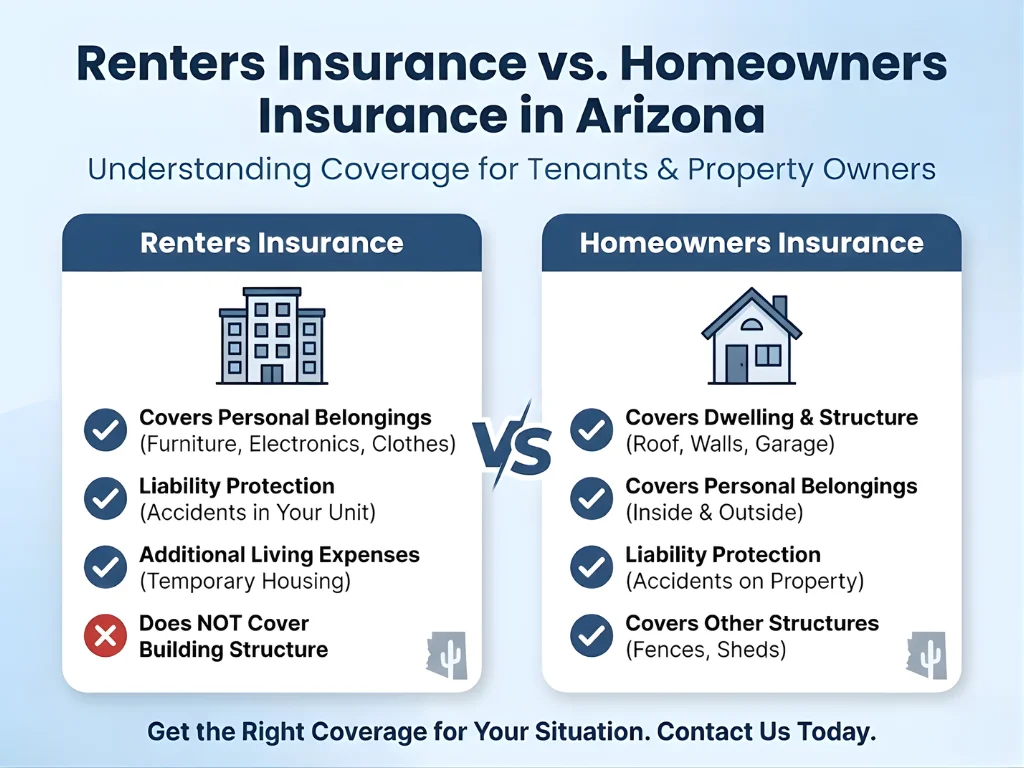
Renters insurance is for people who lease or rent their home—whether it’s an apartment, a house, or a condo. It focuses on protecting your personal property, covering liability, and sometimes providing living expenses if your rented space becomes uninhabitable due to a covered event, like a fire or water damage.
Here’s what makes renters insurance particularly valuable:
- Personal Property Coverage: It pays to repair or replace personal items—like furniture, electronics, and clothing—if they’re damaged or stolen.
- Liability Protection: If someone is injured in your rental or you accidentally damage someone else’s property, renters insurance can help cover those costs.
- Loss of Use Coverage: If your rental becomes temporarily unlivable due to a covered event, the policy may cover hotel bills or other living expenses.
In simple terms, renters insurance doesn’t protect the structure of the building (that’s your landlord’s job), but it protects you and your belongings inside.
What is Homeowners Insurance?
Homeowners insurance, on the other hand, is designed for people who own their homes. It covers both the structure of the house and most things inside it, along with providing liability protection.
A typical homeowners policy includes:
- Dwelling Coverage: This covers damage to the structure itself, including the roof, walls, and attached structures like garages.
- Other Structures Coverage: It covers detached parts of your property, such as fences, sheds, or detached garages.
- Personal Property Coverage: Like renters insurance, it protects your belongings inside the house.
- Liability Protection: It helps cover injury or property damage claims against you.
- Additional Living Expenses (ALE): Helps with living costs if you’re temporarily displaced from home during repairs.
In Arizona, where the climate can be tough on homes (from intense sun to sudden monsoon storms), homeowners insurance can help prevent financial hardship from unexpected damage.
Key Differences Between Renters and Homeowners Insurance
Although these two types of insurance share some similarities, their core structure and purpose differ in significant ways.
| Key Feature | Renters Insurance | Homeowners Insurance |
| Who Needs It | Renters or tenants | Homeowners |
| Structure Coverage | Not included (landlord’s responsibility) | Included |
| Personal Property | Covered | Covered |
| Liability Protection | Included | Included |
| Living Expenses After Damage | Included | Included |
| Cost | Typically low | Typically higher |
| Required By | Often landlords | Mortgage lenders or homeowners themselves |
The main difference lies in ownership versus occupancy. Renters protect what they own inside the property; homeowners protect both the structure and contents.
Why Insurance Matters More in Arizona
Arizona’s landscape is as diverse as its risks. Dust storms, wildfires, hail, flash floods, and even earthquakes can affect different areas. Both homeowners and renters need to consider these local risks when choosing coverage.
Common Arizona-Specific Risks
- Monsoon storms: High winds and heavy rains can cause roof leaks, flooding, and structural damage.
- Wildfires: Particularly common in rural and mountainous areas, wildfires can destroy homes and personal property within hours.
- Extreme heat: Intense sun and heat can wear down roofs and HVAC systems faster.
- Theft and vandalism: Urban areas like Phoenix and Tucson occasionally see higher rates of break-ins, making renters and property coverage critical.
Arizona’s unique mix of desert and metropolitan life means no one is entirely immune from property damage or loss, even if they live in a safe neighborhood.
Coverage Details: What Each Policy Includes
Renters Insurance Coverage
A standard renters policy includes several core components:
1. Personal Property: Covers your belongings against covered perils such as fire, smoke, theft, or vandalism. You can often choose between actual cash value (ACV) and replacement cost coverage. ACV accounts for depreciation, while replacement cost gives you what it would take to buy the item new.
2. Personal Liability: Covers legal or medical costs if someone gets hurt in your rental or if you accidentally damage property.
3. Loss of Use: Helps cover the cost of living elsewhere temporarily while your rental is repaired.
4. Optional Endorsements: You can add riders for high-value items like jewelry, art, or electronics that exceed your standard coverage limits.
Homeowners Insurance Coverage
Homeowners policies often follow what’s known as an HO-3 or HO-5 policy, depending on the level of protection.
1. Dwelling Coverage: Pays for damages to the house itself from covered risks—fire, wind, hail, or vandalism.
2. Other Structures: Protects detached parts of your property.
3. Personal Property: Covers belongings inside the home, just like renters insurance.
4. Liability Protection: Covers injuries or damages you’re legally responsible for, whether they happen on your property or not.
5. Loss of Use: Helps pay extra living expenses if you must move out during repairs.
6. Additional Endorsements: You can include flood, earthquake, or sewer backup insurance—important for certain Arizona locations.
Cost Comparison: Renters vs. Homeowners Insurance in Arizona
Typical Costs in Arizona
On average, renters insurance in Arizona costs around $15 to $25 per month. That’s roughly $180 to $300 per year depending on your coverage amount and deductible.
Homeowners insurance costs considerably more because it covers the value of the entire home. In 2025, the average annual homeowners premium in Arizona was around $1,500 to $2,000, depending on location, home age, and coverage selections.
Factors That Affect Cost
- Location: Areas prone to wildfires or storms often carry higher premiums.
- Home Value and Size: The larger or more expensive your property, the higher your coverage needs.
- Deductible: Higher deductibles generally lower monthly premiums but increase out-of-pocket costs when filing a claim.
- Credit score and claims history: Insurers in Arizona often use credit information when determining rates.
- Replacement Value vs. Actual Cash Value: Replacement value policies tend to cost more but protect better against depreciation.
Example:
A renter in downtown Phoenix might pay $18/month for $30,000 in personal property coverage and $100,000 in liability. A homeowner in the same area with a $400,000 property might pay $1,700 per year to insure the home’s structure and contents.
Common Misconceptions About Both
Many Arizonans underestimate or misunderstand what these policies do—and don’t—cover.
Renters Insurance Myths
- “My landlord’s insurance covers me.”
Landlord policies only cover the building structure, not tenants’ belongings. - “I don’t have enough stuff to need insurance.”
Even modest belongings—furniture, clothes, electronics—add up quickly. One apartment fire could cost tens of thousands to replace. - “It’s too expensive.”
Renters insurance often costs less than two takeout meals per month.
Homeowners Insurance Myths
- “It covers everything.”
Standard homeowners policies don’t usually include flood or earthquake protection unless added. - “Market value equals coverage value.”
Insurance covers rebuilding costs, not market prices. These are often two very different numbers. - “I never make claims, so I can ignore my policy.”
Reviewing coverage regularly ensures protection keeps pace with home improvements or rising construction costs.
Choosing the Right Type of Coverage for You
Your first step should always be identifying your living situation and potential risks.
If you own your home—whether a condo, townhouse, or detached house—homeowners insurance is a must. Mortgage lenders typically require it, but even if they don’t, it’s the only way to protect your investment against costly losses.
If you rent, renters insurance provides strong protection without the higher cost of insuring a structure you don’t own. Most landlords in Arizona now require proof of renters insurance before signing a lease.
When to Review or Adjust Your Policy
- After moving or remodeling (to update dwelling or property coverage).
- When acquiring expensive personal items like jewelry or electronics.
- If family circumstances change, such as marriage or having children.
- Annually, to reevaluate replacement costs and inflation.
Keeping policies up-to-date ensures you’re never underinsured when an emergency happens.
Real-World Example: A Tale of Two Policies
Imagine two residents in Scottsdale:
Sara, a renter in a two-bedroom apartment, and Miguel, a homeowner in a suburban house.
When a monsoon storm rolls in, lightning strikes their building’s transformer, leading to a small fire that damages multiple units.
- Sara’s landlord’s insurance covers the building repairs—but not her scorched furniture and ruined electronics. Fortunately, Sara’s renters insurance reimburses her for replacement costs and covers a temporary hotel stay.
- Miguel’s homeowners policy covers his roof and garage damage, plus debris cleanup and reconstruction costs. His insurer also handles repair costs after verifying the lightning claim.
Without insurance, both could have faced thousands in repairs, replacements, and lodging expenses. These simple policies make all the difference in financial recovery.
Tips for Comparing and Buying Insurance in Arizona
Choosing the right provider and policy can feel complicated, but these steps simplify the process:
- Get multiple quotes. Compare at least three insurers to understand price differences and coverage details.
- Assess coverage limits. Make sure your belongings (especially high-value items) are fully covered.
- Check claim satisfaction ratings. Reliable customer service during emergencies matters as much as low rates.
- Understand exclusions. Review what’s not covered—like flooding—to avoid surprises later.
- Bundle where possible. Many insurers in Arizona offer discounts for combining homeowners, renters, and auto insurance.
The Role of Deductibles and Discounts
Deductibles directly affect your premium cost. A higher deductible means a lower premium, but also higher out-of-pocket costs when filing a claim. The best balance depends on your financial comfort.
Common discounts include:
- Bundling multiple policies (home and auto)
- Installing home security systems
- Maintaining a claim-free history
- Using fire-resistant building materials
- Having a good credit score
Discuss these options with your insurance agent to tailor a plan that fits both your coverage needs and your wallet.
Flood and Earthquake Coverage: Special Considerations in Arizona
While Arizona rarely experiences hurricanes, flash floods are frequent during monsoon season, especially in regions like Flagstaff and Scottsdale. Standard homeowners and renters policies typically exclude flood damage, meaning you’ll need separate flood coverage through a private insurer or the National Flood Insurance Program (NFIP).
Some parts of the state near fault zones could also experience earthquakes. If you live near areas like Yuma or the northwestern border, an earthquake endorsement may be wise. These add-ons can be invaluable during rare but damaging events.
Final Thoughts and Conclusion
Both renters insurance and homeowners insurance are essential tools for financial protection in Arizona—but they serve distinct purposes. Renters insurance covers your personal property and liability as a tenant, while homeowners insurance protects your property’s structure, contents, and long-term worth.
With Arizona’s environmental risks—from wildfires to monsoon floods—having the right policy goes beyond peace of mind; it’s a practical necessity. Even if state law doesn’t require it, insurance ensures you’re never left rebuilding your life from scratch after disaster strikes.
Whether you rent a downtown Phoenix apartment or own a cozy Tucson home, the best policy is one tailored to your lifestyle, budget, and environment. Take time to review, compare, and customize your coverage so you can thrive in Arizona’s sun-soaked beauty—fully protected.